
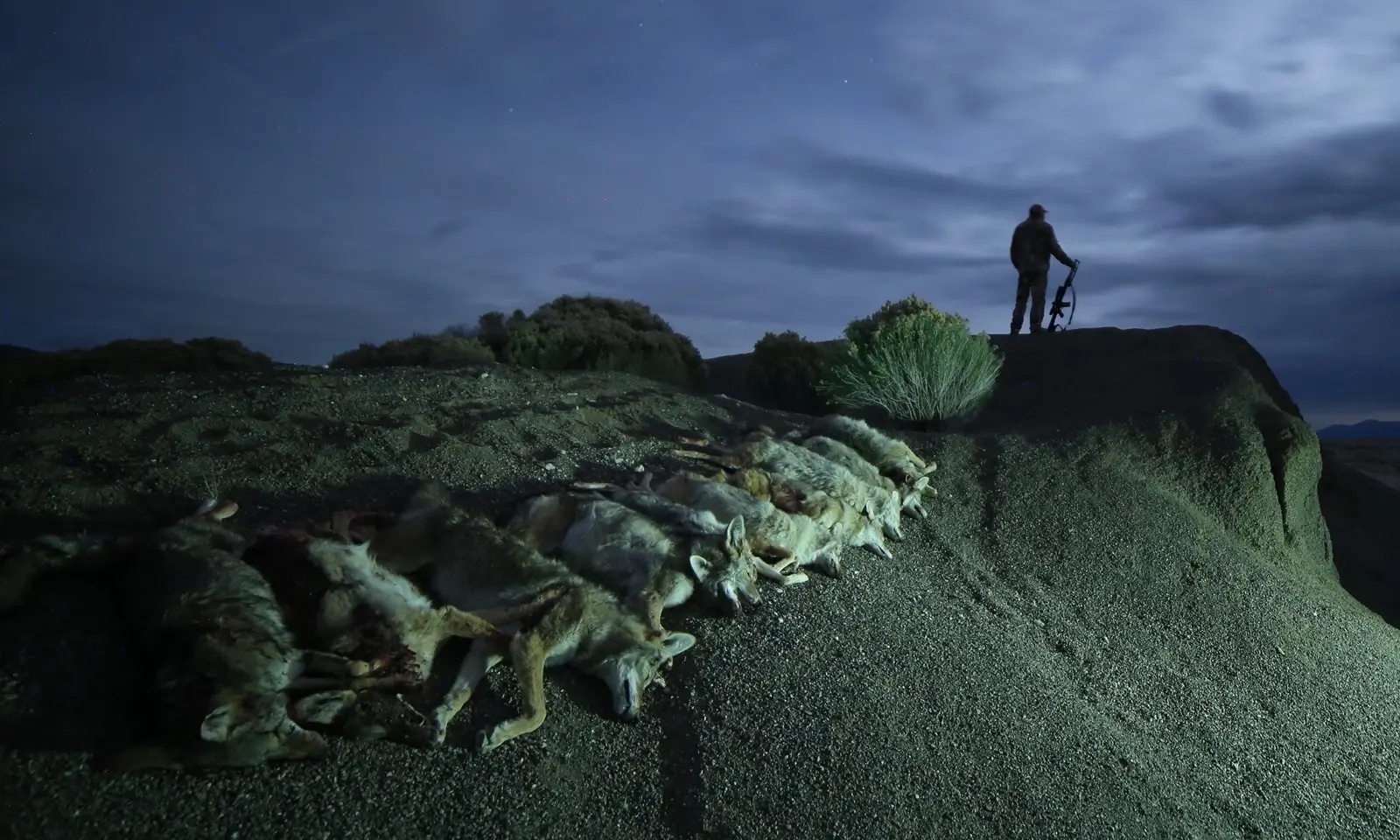
Before anything else: check your state. Night hunting is the single most variable rule in predator hunting — some states allow it outright, some run a defined season for it, some allow a light but not thermal, and some allow none of it. Start at the state regulations and read your own before you buy a thing.
Stand up, and get on a tripod
I prefer to stand while night hunting, unless I can hunt from atop a vehicle — which is illegal in most states. It is almost too difficult to acquire your target without standing. With darkness as your camouflage you do not need to sit in front of a bush to conceal your outline, unless there is moonlight on you.
A lightweight carbon fibre tripod gets your shooting position up off the ground, and a hog or pig saddle mounts the weapon safely and lets you rotate left to right quietly. You can leave the gun on a system like that while you scan with a handheld.
I cannot recommend a tripod highly enough — it is close to essential. Stand in an open spot away from trees and brush, but keep something behind you under moonlight to break up your outline. If you are using a light it will hit the trees and branches around you and make them obvious to an approaching animal; a big white-barked tree acts as a reflector and shines light straight back onto you. In that respect it is the opposite of day hunting.
Calling coyotes at night
Sound travels farther at night, and the wind usually calms, so your sound gets maximum projection. Because of that we play distress on lower volume than we would in daylight.
Night hunting coyotes is a vocal game. Howl and locate, then move closer before you play distress. We stick to higher-pitched sounds after dark and howl more than we would in the day to get responses and work out where they are. They tend to come slower at night and work downwind, so we usually set up on the downwind side and expect the dogs to come to us.
Lights, thermal or night vision?
My favorite way to hunt at night is thermal. It is close to cheating. With a good unit you can see animals hundreds of yards out in complete darkness.
Whatever your budget and your local law allow, plan for two devices: a handheld scanner and a weapon-mounted one. Scanning with your weapon is impractical, it will wear you out on the first stand, and it is loud — an approaching predator will hear you stumbling around the tripod.
Thermal sees heat, so it works in total darkness and through light cover, but not through glass — you have to roll the window down, which gets cold in January. Night vision needs a high-powered IR illuminator for a genuinely sharp image, but it does see through glass, so you can scan fields from inside a truck. Lights are the cheapest way in, and a kit that combines red, green and white settles the color argument by giving you all three.
If it is thermal you are pricing, start with the detection and identification figures rather than the magnification. Detection range is the distance at which something warm shows up; identification range is the much shorter distance at which you can tell a coyote from a dog, and identification is the number that keeps you legal and honest. Both are published, so compare them across Pulsar and ATN before you compare prices. I have written up how the bands actually shake out on thermal scopes for coyote hunting.
Some states make parts of that illegal. Read your regulations before you spend the money, not after.
Hunting coyotes at night without thermal
You do not need a thermal to kill coyotes at night. How to hunt coyotes at night without thermal comes down to one idea: the light is your camouflage. Most night hunting happens around the new moon, and a coyote’s eyes are built for that dark; put a beam on them and their eyes adjust to the brightness, and they cannot pick you out of the black behind it any more than you can see past a flashlight pointed at your face.
Scan fast. Back and forth, quickly, catching eyes rather than bodies. If a field takes you more than five seconds you are going too slow. Coyote eyes at night show as a pair of reflections at the edge of the beam. Once you have them, follow the animal with the edge of the light rather than the center, and do not take it off.
Color is an argument nobody wins. Red is traditional and makes eyes pop, green shows you a little more, and I have gone to white because coyotes, fox and bobcat all come to it on film. Pick the one you are leaning toward; the coyote hunting lights I run combine all three. Judge your ranges before you start calling, because the ground looks different in the dark, and I will not shoot much past 125 yards at night. The tips below have the rest of it.
Before you scroll: these tips took a lot of blank stands to learn. I send the new ones out as I find them — get them by email, a few times a season, nothing else.
Part 6 of 6
The tips, 93 to 101
After dark
Tip 93: Pre-scout by day, shoot off a tripod
Don’t expect to find good locations in the dark! Spend time during the day marking stands to hunt at night. As you travel the area, or hunt it in the daytime, make notes of places you’re saving for hunting coyotes at night. It’s really hard to drive around and spotlight places you want to hunt during the night. Scout it out beforehand!
I prefer to stand while night hunting, unless I can hunt from atop a vehicle, which is illegal in most states. In fact it’s almost too difficult to acquire your target without standing. Yes, that’s right, hunting at night almost requires that you stand up in order to see the predators better.
With the darkness as your camouflage you don’t need to sit in front of a bush or tree to conceal your body’s outline, unless you’ve got some moonlight shining on you.A lightweight carbon fiber tripod will allow you to get your shooting position up off the ground. To mount your weapon safely, you’ll need something like a hog saddle or pig saddle. This will allow for quiet and easy rotation from left to right. You can leave your gun on a system like this to scan with lights, night vision, or thermal devices.
I cannot recommend a tripod system highly enough, they are almost essential to your success. Stand in an open spot away from trees and brush, but keep something behind you when hunting under moonlight to breakup your outline. If you’re using a light, it can hit trees and branches around you making them noticeable to approaching animals. A large white barked tree can act as a reflector and shine light onto you. It’s quite the opposite of day hunting in some regard.
Sound travels farther at night than during the day. The wind usually calms at night as well allowing your sound to get max sound projection. Because of these things we play our distress sounds on lower volume. Coyotes are very vocal at night most of the time, you can howl and locate, then move closer to play distress sounds. We usually stick to higher pitched sounds at night, and howl a little more than in the day to get responses and determine where they are at. Coyotes tend to come slower at night and work down wind. We usually set up on the downwind side anticipating the dogs will work toward us.
My favorite way to hunt at night is with thermal. It’s like cheating honestly. With high quality thermal devices you can see animals hundreds of yards out in complete darkness. I’ve even used a pair of $80,000 binoculars that let us identify animals at damn near a mile!
No matter what your budget or local laws allow for, you need to account for a hand scanning device and weapon mounted device. Scanning with your weapon isn’t practical and you’ll wear yourself out on the first stand. It’s also very loud and an approaching predator will pick up on the noise you’re making as you stumble around your tripod scanning.
For thermal, I use a monocular and I prefer this Pulsar monocular, and then I have a thermal scope mounted on my rifle. If I’m using lights I have this Wicked Lights Kit that has a hand scanner, and weapon mounted light. It also solves the light color debate by combining green, red, white and an 850nm infrared into one light.
Night Vision is nice, but to get a high quality image you’ll need a high powered IR scan light to illuminate your subject. Take a look at the new Sightmark Wriath setup if you want to go the budget night vision route, with a hand scanner like this monocular. Night vision can see through glass, where thermal can’t. You can drive down the road blacked out with night vision, and scan fields as well. Thermal requires rolling the windows down and that can get nippy in the winter time. It may not matter because some states make all of that illegal, remember to follow your local laws so that you don’t lose your hunting privileges.
Tip 94: Red or green? The best light color for coyote hunting
Ask three hunters and you’ll get four answers. I’ve started using white. I film my night hunts, and I’ve noticed that coyotes, fox, and bobcat will come in to a white light. White is ideal, but I know some prefer green or red. You can see a little better with green vs. red. Eyes pop with red. Red is more traditional. Green is more popular. See, now you’re even more confused. I say choose what you’re leaning toward. Watch the preview below, and see they’re using white light, and a lot of it.Night hunting under white light — Night Crew Tip 95: Scanning tips
While hunting with Texas night hunters you learn real fast how to scan at night. Do it quickly. Scan back and forth really fast. You’re objective is to catch eyes, not see an animals full body. If you realize your goal is to hit something reflective, you’ll understand that quick scanning is best. If it takes you more than five seconds to cover a field, you’re going too slow! When scanning with a partner, split the field in half, then don’t overlap your scanning until you see something.Tip 96: Coyote eyes at night: halo them, don’t blind them
Once you’ve identified a pair of eyes, use the edge of your light as a “halo” effect to follow the animal. Most of the time you want to avoid shining the brightest part of the beam directly into their eyes. Once you get light on them, don’t take it off. Some don’t care about using a halo method, the video above shows that it doesn’t matter much. Not all coyotes respond the same, no two dogs are alike. Treat them different as you watch their body language. Remember, the light is your camouflage!Tip 97: Wiggle the light
When hunting with a partner and especially with a cameraman, let them know you’re on an animal by wiggling the light every once in awhile. The person with the light can see the eyes reflecting, but a person standing five feet away might not be able to see the same thing. Let them know by wiggling the light that you have something in your line of sight. This also prevents you from speaking, it’s best to use non-verbal communication when you can.Tip 98: Shooting distance at night
Judging the distance at night can be hard to do. Make some mental notes before you start calling as to what you think the range is in the area you’re calling. Talk to your partner about range estimates and familiarize yourself with the terrain. It looks a lot different at night. I will not shoot much further than 125 yards at night. I don’t feel it’s ethical to take long range shots at night. You never know if it’s the neighbor’s dog, a deer fawn, or what’s behind the animal that could cause potential harm. Be safe and make good shooting decisions at night. Don’t do something that you’ll regret later.Further reading
Tip 99: Moon phase after dark
Most night hunting occurs around a new moon. Canines can see really well at night, and a moonlit night is perfect for them to hunt and peruse for food. This is why you need to use the light as your camouflage. The light forces their eyes to adjust to the brightness. They can’t see as well because it "blinds" them to anything in low-light. You’ve created a new contrast, and their eyes won’t pick you out like they might have done under the moonlight. Just like when a cop approaches you at night with a flashlight, it’s blinding because your eyes have to adjust.
Wrap up
Tip 100: Respect the animals
Some "predator hunters" feel like a coyote is nothing more than a bug that needs to be squashed. Take the high road, respect the animal. They are a unique species, a survivor, and an opponent that should be commended for their resilience!Tip 101: Have fun
Get off your backside and go out and hunt. Stop watching videos, stop reading articles — including this one — and get out there and do it. Learn by doing. If you fail, learn from that too. I'm not the ultimate expert, but I'm better after every time I go.
From the field
Questions and answers from hunters over the years. Comments are closed; contact me if you spot something out of date.
Unofficial A. · 2016-09-02
Thanks for the article… good advice. I’ve been hunting with night vision for a few years and find that the IR light will bounce off of any obstruction (tall grass… sage brush… etc, making seeing past it difficult, so it’s best to find a wide open space and look for coyotes to come to the edge of cover to investigate your calls. You can then shoot them as they hold up inquisitively, or wait for them to try and sneak in. Another thing to avoid is having reflective surfaces of any kind visible…. moonlight and distant house lighting can reflect off of your tripod and a stainless steel barrel wiggling around at night will get you busted about as fast as talking out loud. Covering stainless barrels and/or spray painting reflective surfaces with a flat/matte paint will definitely help on even nights when there is a quarter moon. As always… I try to park my car out of view as the paint and glass are a dead giveaway at night… they are highly reflective and stand out as much as during the day, even on new moons if there are lights coming from local residences (miles away). When moving in an area with distant light sources… get low…. and move slowly. Coyotes have great eyesight… and hearing… and although they may hear you moving into your stand… if you are upright with light sources in the country behind you… they will easily see your dark silhouette moving as the lights behind you become obscured with your passage. Try to use trees, shrubs and other fauna to mask your approach. Go slow and easy…. a single miss step on a branch or bumping into a wire fence (barb, electric, or otherwise) can ruin a good stand in more ways than one! Lastly, If you hunt at night… you know that light is your enemy and although I’ve had some people tell me that coyotes can’t see green or red lights… this is not the case. I have a buddy that came up from Nevada to hunt the very day he got a night vision scope. I got him on a coyote at about 75-100 yards… in the middle of a field. I was in front of my friend scanning with a thermal handheld… so I indicated that there was a coyote by quietly tapping him, he engaged his night vision scope. Out of no where… the coyote busted into a dead run in the opposite direction. I was stunned because there was nothing that should have given us away, (sounds or dramatic movement). I turned my head around to my left to see my buddy with his gun down and his night vision scope’s eyepiece shining NV green on his jacket, neck, and lower face as he was getting it ready. I about laughed! Coyotes might not be able to see green, but they can see the light itself and with it bouncing off of his person and his slight movements… he likely looked like a beacon out there in the night. Be wary if using night vision or thermal, to guard against the light that is emitted from your scope’s eyepiece. It will reflect off of your cheeks, and eye-socket… and if you are scanning left/right… will stand out like a sore thumb. I wear a hood that drapes out in front of my face so that the light goes inside the hood… but the hood itself blocks the shine off my face to the left and right of me. This has greatly increased my success in the field. That’s about it… I’d love any other input as I’m sure there are still ways to improve my night hunting techniques. I might be an old dog… but I’m still open to new tricks!
Martin · 2016-12-31
I use night vision scope for night hunting. Any tips for that?
Gary G. · 2017-02-10
I’m just trying to protect my property. We have a pack that has become very active & where we used to hear them in the distance we get full pack howling right in our yard some nights. I live in a very secluded area, probably a 1/2 mile from the closest house, & in my state they are legal to kill without a permit, on your own property. I know which direction their den is & I can bait them within a 100 yards of my elevated deck. I was thinking about using sardines, & a call. The sardines WITH SOY worked for my uncle & his fox problem. It was irresponsible it seemed. I have been thinking of hunting them @ dawn & dusk, but I have to do something now. I have over planned I think, LOL, like you were saying. Your article was very helpful in clearing up a few myths, & giving me a kick in the butt. Thank you, & if you have any tips for me, I would be forever grateful.
daniel · 2017-04-19
coyotes do not like soy i tryd that trick 2 years ago they were within 200 yards of my bait i was hidden the didnt see me i know that for a fact they smelled the soy and high tailed it outta there i got one on the ground he was 40 pounds they hate soy never worked for me in indiana
Steve · 2018-01-25
Stumbled on a den in the spring scouting for turkeys. Mother moved pups one died when I got back to den 2weeks latter. Went in that area to hunt Jan 2018. No signs of coyotes. Only one I ever killed (western Pa)was when I was turkey hunting near a pond in total Camo calling to turkey gobblers. Had 2 coyotes rush right into me so I turned and shot closest at 30 feet with 12ga turkey load. Other one stood and looked at me 80 yds away then turned an ran. I was then hooked on coyote hunting. See more in turkey season than any other time. Would love one come to electronic call.
Disappointed · 2018-06-12
When I surf and find an interesting link I right-click the link and open it in another tab. This allows me to continue to read the current article and go read the other one later. On this site I cannot right-click because the web developer has locked that feature. I’ll not be frequenting this site or visiting many links here for that reason. Content is great, and what’s here seems interesting but I cannot stand to be forced to surf, or do other things, someone else’s way.
Jason C. · 2020-07-23
My name is Jason and I’m 44 year old I have a17 and 4 year old boys, and I would love more than anything to go hunting with them like I want to. You see 10 year ago I was charged with demestic despute, newly married to a lady that came from a abusive husband. One night working on my truck,I was cussing and going on,not thinking about what my wife must have been going through,but when the cops showed up a took me to jail I had time to think then. So I got out of jail went back home we talked and I made a mistake and she made a mistake also by calling the cops but I understand why she did so time to go to court. She stood up and told the judge what had happened and she was dropping the charges the judge was ready to dismiss it when the DA stood up and said he was taking it over. He took me in a room and told me this was my options plea guilty to demestic violence or spend 3 years in jail. Being a working man supporting a family I didn’t see how I could do 3 years so I plead guilty to demestic violence even the judge asked the DA if he was sure about this and he said yes he was going to make an example out of me but I’m not a angel but I didn’t deserve that because it coasted me my 2nd amendment rights I couldn’t go hunting with my boy like I would have liked to do it’s just wrong that I can’t even take him spurriel and rabbit hunting if anybody can or would help me please for the love of God help me I tried everything I know to try. God bless all of y’all
John · 2020-11-07
As you have learned the hard way, others can learn from your experience. If you are ever cornered into a plea with a DA on a DV charge, Stop talking immediately with the DA and immediately request/hire a lawyer and battle it out in court. Once the DA knows you will fight, burden of proof is then on the DA and it may not be worth their time if the ‘victim’ tells the jury her prior history and that she jumped the gun due to flashbacks. If you have a squeaky record (no DUI, drug charges, etc.) it would be very hard to profile you as a violent and non-law abiding person and the jury and/or judge may dismiss the case. Heated Arguments in relationships happen all the time. Every Judge and Jury knows that alone isn’t enough to convict someone for DV. Always…always…always… try to get the case dismissed with a qualified attorney. You would be amazed at all the technical or procedural reasons a case can be dismissed. Going it alone will work against you and it’s just not worth it. DA are more than willing to strip 2A rights away from even innocent people otherwise.