
Almost everything on your caller is trying to give a coyote a reason to come. A rabbit in trouble, a pup in trouble, a rival on his ground. All of it adds something to the pot.
A confidence call works on both sides of that. It doesn’t only add a reason to come. It also removes a reason to stay away. The second half is the part hunters underrate, and it changes when you’d use one and what you should expect from it.
It isn’t competing with your distress sound. It runs underneath it, doing a job the distress sound cannot do on its own.
What a confidence call actually is
A confidence call is an ordinary, everyday sound that a place makes when nothing is wrong with it. Birds carrying on. Feeding sounds. Nothing in distress, nothing threatening, nothing that says anybody is being hunted.
Think about what a coyote is walking into. Somewhere ahead of him there’s a rabbit screaming, which is interesting. What he doesn’t know is whether the rabbit is screaming because a hawk has it, or because a bobcat has it, or because a man in the sage is holding a remote. He’s building a picture, and the picture is mostly made of what he can’t hear.
Woods that have gone quiet are a warning. Every hunter knows this from the other side of it: you sit down, everything shuts up for ten minutes, and then the birds start again and you know you’ve been accepted. A coyote reads the same page. A confidence call puts the ordinary noise back into the scene so that the only unusual thing in it is the dying rabbit you want him focused on.
That is the subtracting half of it, and it is the half that is easy to miss: the sound takes away a coyote’s reason to doubt what else he is hearing.
Why it’s birds, and specifically these birds
Animals listen to other species’ alarm calls, and this is not folklore. A review covering the field found eavesdropping on other species’ alarms demonstrated experimentally in around 70 vertebrate species, across playback experiments on 74 species in 41 families of birds, mammals and lizards. The same review notes birds may be a more common source of danger information than mammals are. Birds sit above everything and see it first.
I am not aware of a study that put a coyote in front of a speaker and measured his response to magpies. What the research establishes is that the mechanism a confidence call depends on is real and widespread, not that somebody has measured it in this exact species. Take it as a well-founded reason rather than proof.
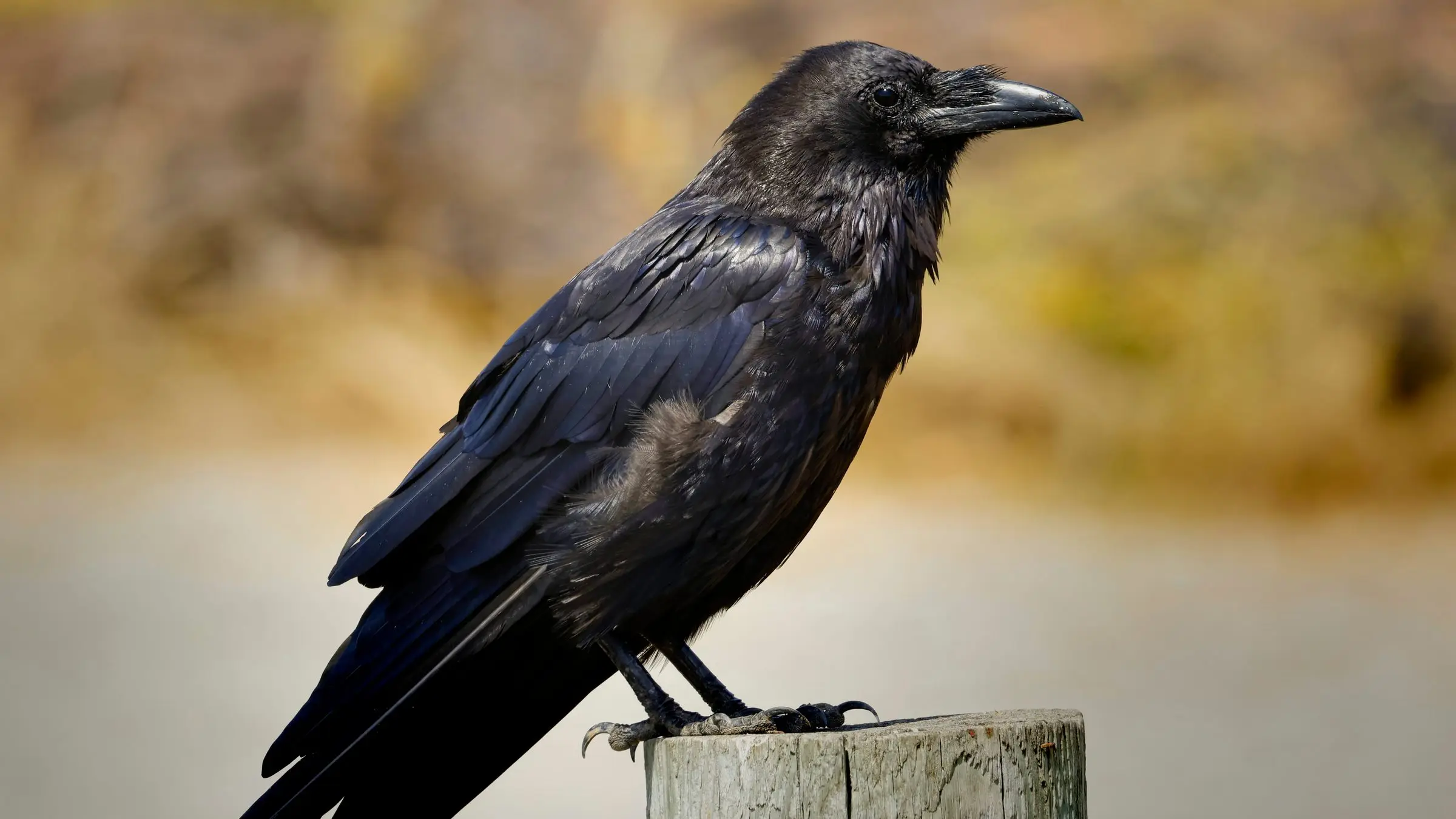
Corvids are the right birds for the job for reasons you can see any day you’re out. They’re loud, they’re everywhere, they sit high, and they are relentlessly nosy about carcasses.
I got shown exactly how nosy a few seasons back. I killed a coyote on an alfalfa pivot at about 200 yards, and it was a bad first shot. He yelped and kiyi’d like he’d been hit by a car, and I put him down with a quick follow-up. I walked out maybe two minutes later, and before I’d even got to him the ravens and magpies had already landed and started pecking at his eyes.
Two minutes. They heard the distress, read it as an easy meal, and beat me to a coyote I had shot from 200 yards away.
So a magpie working a spot is not a neutral sound to a coyote. It can be the sound of something dead that somebody has already found, which is a coyote’s favorite thing in the world. And when it isn’t, it is still the sound of a field with nothing wrong in it. Either reading works in your favor.
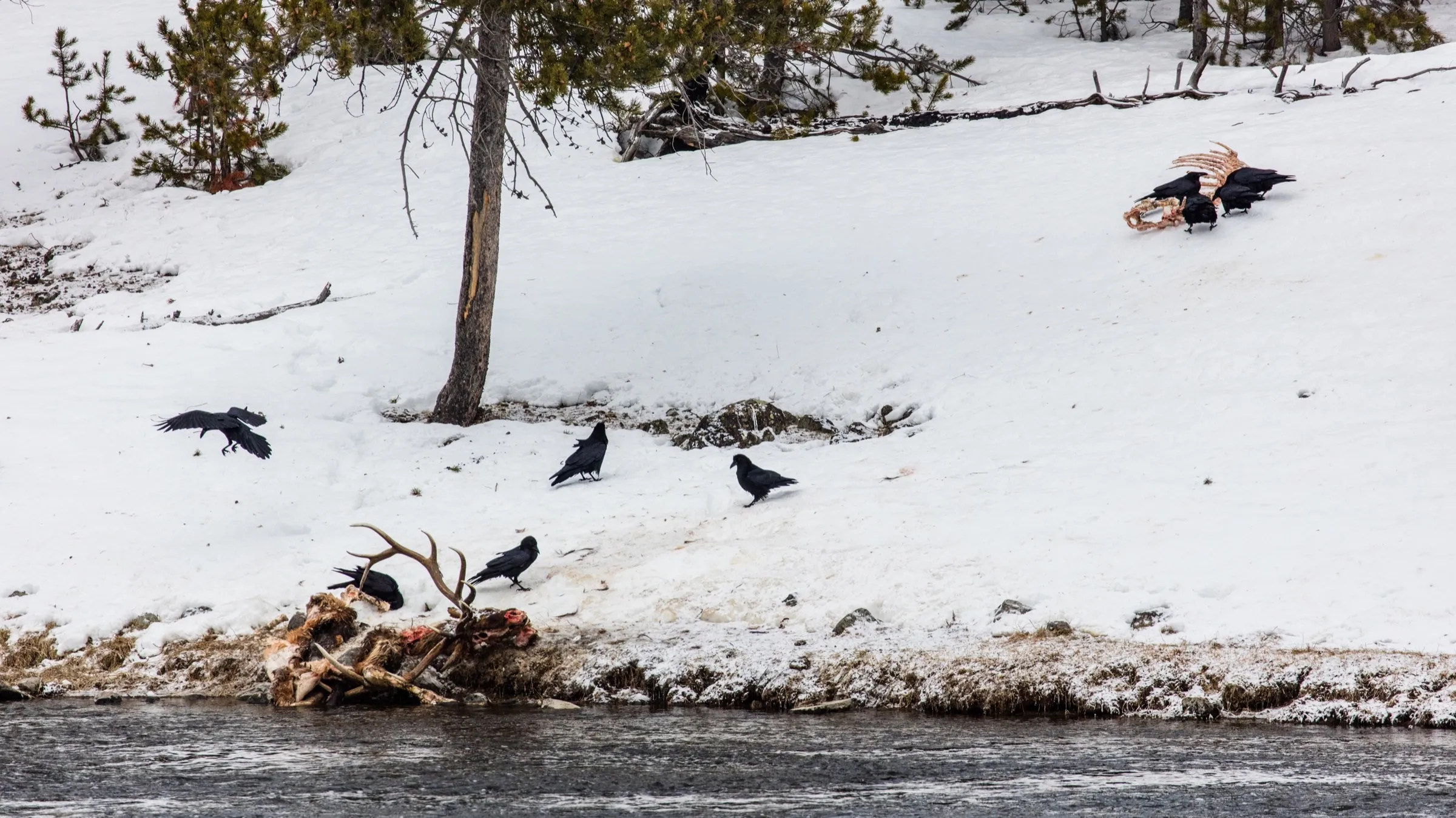
Birds piled up on a carcass, seen from about the distance a coyote would see it. NPS photo, public domain.
Early season is when they earn their place
If you only reach for confidence sounds at one time of year, make it late summer and early fall.
Late summer into early fall is a young-dog game. The pups are grown, they’re moving off, and they’re the most callable animals you’ll see all season. They’re also the most easily intimidated, and this is where a lot of hunters hurt themselves without knowing it: they open with a mature coyote howl and push a young dog away instead of pulling him in. A coyote that hasn’t held ground yet has no reason to walk toward an adult announcing himself. He has every reason to go the other way.
So early season the order that makes sense is bird sounds first, then simple prey distress, and vocals held in reserve. You start by making the place sound normal, then you put something to eat in the middle of it, and you skip the part where you tell a nervous adolescent that a bigger coyote has claimed the place.
Later in the season, when the naive animals are gone and you’re working adults who’ve heard a dying rabbit before, the calculation flips and vocals start earning their keep. The month-by-month starting points lay that out.
Crow, raven or magpie: which one where
Use the bird that actually lives on your ground. A magpie fight in country with no magpies is a sound a coyote has never heard, and the whole point of a confidence call is that it should be unremarkable.
- Crow — the safe default almost anywhere in the country. If you're not sure, run crows
- Raven — the West, the mountains and the high desert. Where ravens are the bird you actually see on a carcass, they beat crows
- Magpie — the interior West and the northern plains. My favorite of the three where they live, and worth a look in sage country
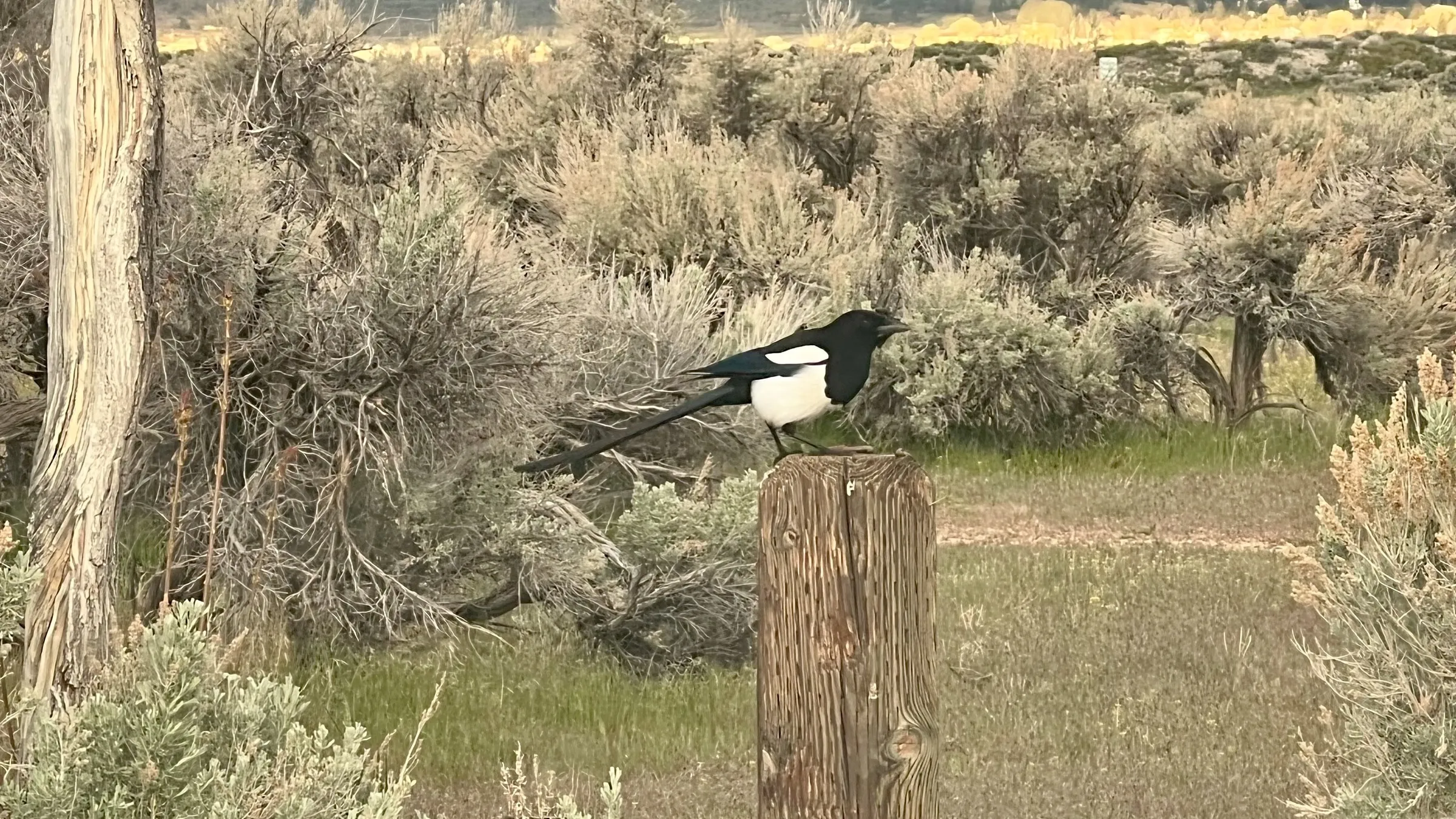
A black-billed magpie on a sage flat in Nevada. My favorite of the three, where they live.
The fight sounds are the adding half
Plain bird chatter mostly does the subtracting. The fight and gathering sounds do the other half as well, and that is why they outperform a lone bird by so much.
Corvids do not squabble over nothing. When they fuss and scrap like that, they are arguing over morsels of something dead or dying, the same way predators bicker over a kill pile. Nobody fights over an empty field.
So a crow fight is not a neutral sound. It says there is food here, there is enough of it to be worth fighting about, and the fight is already underway. A coyote hears birds piled up in one place and reads it as a free meal that somebody else found first, which is exactly the kind of invitation he is built to accept.
That is why I reach for Crow Fight, Magpie Fight or a raven flock over a single bird almost every time. A lone crow says the place is fine. Several birds arguing says the place has something in it.
Watch the birds. They are the best tattle-tales you have
This half is not about what you play. It is about reading what the birds are already doing, and it might be worth more than the sounds are. They tell you two things: where to hunt, and when a coyote is on his way.
They tell you where to hunt
We were driving to new country near first light, and I was in the passenger seat looking out the window. About a hundred yards off the road there were twenty-odd ravens and a few magpies on the ground in a field. I could not see anything dead from the truck. I made my partner turn around anyway.
We pulled off and set up 300 yards downwind of the birds, and we got in quiet enough that we never bumped them. I ran a cottontail distress on the Lucky Duck Revolt at 13 out of 32 on the volume. Low, and low on purpose: with that many birds working I had to assume a coyote was already bedded or lurking somewhere close, and there is no sense blasting a dying rabbit at an animal who might be inside a hundred yards.
Ninety seconds in, a young male came straight to the call and my partner rolled him. We kept calling, worked the volume up the way I normally would, and mixed in a crow battle. At about eight minutes a mature female came out of the same ground the birds were working, and I dropped her for the double.
We nearly drove past it. Another mile and we would have been five miles up the road on our way to a spot we had picked off a map. The birds picked a better one.
I never did find out what they were on, or whether they were on anything at all. That is the point worth taking, and it took me a while to get it: it does not matter.
Birds on the ground are working as live decoys whether or not there is a carcass under them. They are real movement, real noise, and real animals behaving as though the place is safe, which is the whole thing a confidence call is trying to fake. A coyote reading that group does not need a dead pile to be there either. He only needs the field to look like somewhere worth walking into.
So the sign is the birds. Not the carcass you cannot see from the road.
They tell you a coyote is coming
Corvids give away approaching coyotes. They often come in with one, riding along above him because they know perfectly well what a hunting coyote might leave them. And they will buzz him, swooping down at a coyote working through the open. If you learn to read that, you get a coyote spotted well before you would otherwise have picked him out of the brush.
So on stand, do not only listen to your own call. Watch the sky and the fence lines. A magpie that suddenly drops out of a tree and starts diving at something in the sage is telling you where to point your rifle, and it is telling you a good deal earlier than your eyes would have managed on their own.
Birds going abruptly quiet is the same message inverted, and it is usually about you. If everything shuts up right after you sit down, you have been noticed, and the sensible move is to give it ten minutes before you make a sound.
How I run them
- Open with it — thirty seconds to a minute of birds before any distress, so the stand sounds settled before you put a rabbit in it
- Keep plain chatter under the distress — ordinary birdsong is background. If somebody a quarter mile off would notice the birds first, it's too loud
- A fight is not background — the squabbling sounds are a draw in their own right, so they can run at distress volume or lead a sequence outright
- Come back to it in the gaps — between distress sequences, rather than leaving dead silence that a hung-up coyote can stand and think in
- Plain chatter won't carry a stand on its own — ordinary birdsong settles the place without making anything worth coming for. A fight sound does more, but something still has to be on the menu
- A decoy makes it a scene — a crow decoy set where a bird would actually be, up off the ground, is the visual half of the same idea
That last one decides more stands than it looks like it should. A coyote that arrives and finds noise with nothing to look at is a coyote that goes downwind, which is the most common way a stand quietly fails.
The one I carry is a plain plastic full-body crow decoy on a stake, about sixteen dollars. I set it on a bush or a tree branch above the caller rather than on the ground, because that is where a crow would sit and a crow standing in the dirt looks wrong. It weighs nothing and it lives in my bag, which is most of why it gets used — a decoy you have to decide to bring is a decoy you leave in the truck.
The crow is a visual aid rather than an attractant. It brings nothing in on its own. It gives a coyote who is already coming something to look at when he reaches the place his ears sent him to.
The moving decoy is the one doing the pulling, and that is a different piece of kit. A spinning critter at the caller is what turns a cautious approach into a charge, and it is worth more to your stand than the crow is. Which one to buy, including the two Mojos I use, is on the gear page.
Hand calls over the top of the e-call
When there are two of us we will often run a mouth call over the top of the e-call while it plays a rabbit. It layers a live voice over the recording, and the two never line up the same way twice, which is closer to what a real animal in trouble sounds like than a loop is.
The exception is where your partner is sitting. If the downwind man is set well off the caller, 150 yards or so, leave the hand calls alone. The sound now comes from him rather than from the speaker, and a coyote circling downwind gets a fix on a man instead of on the spot you wanted him looking at.
The sounds to look for on your caller
Names and numbers below are read off the manufacturers’ own current lists rather than remembered.
FoxPro publishes the deepest corvid selection of any library I know, and its sounds carry numbers, so these are exact. From the FoxPro sound list:
- Crows — 270 Crow Fight, 271 Crow Party, 272 Crow Duet, 278 Crow Gathering, 280 Crows, B52 Crows 2, 273 Ugly Crow
- Crow conflict — 276 Crow + Hawk Fight, 277 Crow + Owl Fight. A mobbing scene, and the most "something is happening over there" of the lot
- Ravens — 531 Raven, B51 Raven Duet, 532 Raven Pair, 533 Raven Flock, 268 Feeding Ravens
- Magpies — B50 Magpies, 530 Magpie Fight
- Bird and prey together — 013 Crows + Rabbit, Z09 Ravens + Jack Rabbit, Z08 Magpies + Jackrabbit. One file that does both jobs, and a reasonable way to try the idea without touching your sequence
Lucky Duck ships its callers with a library put together by Rick Paillet, which is why his name and the brand come up together. The sound library carries Crow, Crow Battle, Crow Gathering, Lone Crow, Rowdy Crows and Crow Distress.
Rick Paillet sells his own sounds through Verminator Predator Calls, and this is where I’d go for magpie specifically. His Crow & Snow Goose pack carries Lone Crow and Rowdy Crows, and his Bird pack is the one worth the eight dollars: Magpie Chatter 1 and 2 are the confidence sounds, and Magpie Distress 1 through 4 are there when you want the other thing. The same pack has Blue Jay, Scrub Jay, Jay Bird, Starling, Meadowlark and Woodpecker. Rick and Cindy have been good to me over the years. The packs run five to eight dollars, which is not much to test an idea with.
The other libraries worth a look, because a sound list changes more often than an article does and yours may differ from mine: ICOtec, Primos, Johnny Stewart, Wildlife Technologies and MFK Game Calls. MFK built its name on coyote vocals rather than birds, so it’s the better answer to a different question.
The hand calls
A crow call on your lanyard costs less than a tank of fuel, needs no batteries, and gets you the one thing an e-caller cannot: the sound comes from you, so you can answer a real bird that just landed, or shut up the instant a coyote steps out. All three below were checked and in stock the day this was written, and the last two were down to single-figure stock, so they may need a re-check by the time you read it.
- Faulk's Walnut Crow Call C-50 — the old-fashioned walnut one, and the one I'd buy. Around $24
- Primos Power Crow — sold as a turkey locator, works fine as a crow call, and it's loud. Around $14
- Haydel's TC-87 Triple Tone — three tones out of one call, so you can make it sound like more than one bird. Around $15
One thing no library can sell you, and it’s the reason to bother with any of this: the birds on your ground already do it for free. If you sit long enough to hear the magpies come back after you’ve settled in, you’ve just heard exactly what you’re trying to imitate, and you’ll pick the sound that matches it without having to be told.
If you’re still choosing a caller, that’s a separate question with a real answer. If you want the mechanics that sit underneath all of this, part four of the tips runs the stand in order. And whatever you play, check what’s legal where you are, because electronic calls are restricted in more places than people expect and that’s a per-state question.