
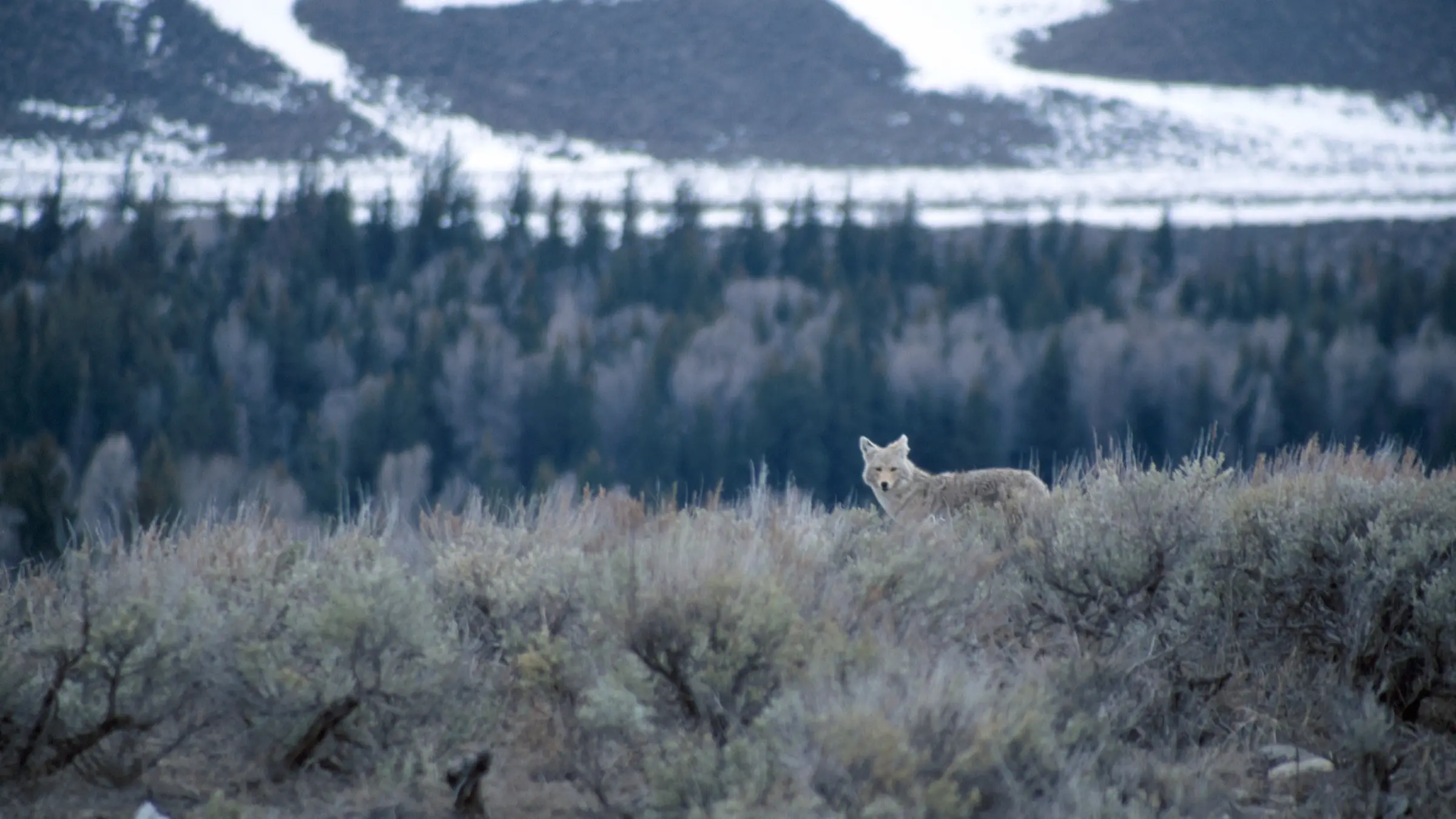
A coyote that stops at 400 yards and won’t come another step is telling you something. He nearly always is. The problem is that the things he could be telling you look almost identical through a scope, and most hunters reach straight for the flattering one: that dog’s been called before.
Sometimes he has. More often he hasn’t, and something you did, or something you never saw, put the brakes on him. I get a hang-up now and then and there’s usually a reason behind it, so these are the seven I work through, roughly in the order I rule them out.
One caveat before you start, and it’s the same one that opens the calling guide. There are no hard and fast rules here, only things that improve your odds. The moment you decide a coyote will always do something, the next one will prove you wrong.
1. He’s been called before
This is everybody’s first answer, and it’s the one you can do the least about, which is probably why it’s so popular.
The tell is the bark. A coyote that starts barking at you before he’s covered any real ground toward the call didn’t hang up. He busted you on the walk in, or he’s heard that exact sound over a muzzle flash before and he’s warning everything in the drainage about you. That’s a different behavior from hanging up. A genuinely hung-up coyote is usually quiet, standing there working the problem out.
If you’re getting barked at on stand after stand in the same country, you’re not hunting educated coyotes so much as you’re hunting coyotes you educated. Rest the ground for a few weeks. Change what you’re playing, and change when you’re playing it, because a dog that’s been burned on a rabbit distress at first light hasn’t necessarily been burned on a challenge howl at noon. The sound library on a decent e-call is worth more than most people use of it.
The honest limit: you can’t confirm this one. Nobody can. It’s the answer you land on after you’ve ruled out the six below, not the one you lead with.
2. He hit a line you can’t see
Coyotes hold territory, and the boundaries are real even though nothing about them is visible to you.
The tell is that he turns and travels. A coyote who saw something he didn’t like stops and stares. A coyote who has hit a territory line hits the brakes and then runs the line, working down a fence or a creek bank instead of leaving. He isn’t scared. He’s out of room.
We were calling a wide-open valley in Nevada and brought two out. They came to about 350, stopped on the far side of a two-track, and that was as far as they were ever going. I worked through everything I had to pull them that last bit. Rodents, pup distress, all of it. Neither one took another step toward us. One of them would walk a little way along the track, stop, and sit down. Then get up and do it again further on. Eventually the pair of them went off up the road and left.
We never fired, because we kept waiting on the closer shot that was never coming. That is its own lesson and I’ve paid for it more than once.
Driving out, we came up onto that two-track and there was scat everywhere. Not scattered through the sage. On the road, the length of it. Whatever line those two would not cross, they had been marking it all season, and it was lying in plain sight the moment we got out of the truck.
That behavior is better supported than most hunting lore. When researchers watched neighboring coyote packs in Yellowstone’s Lamar Valley through a winter and mapped every scent mark they could see, the marks piled up on the edges of territories rather than the middle, and the adjacent territories showed no overlap at all. Not a little overlap. None. The line that stopped your coyote is a line somebody has been marking and defending all year.
The features that end up carrying those lines are the ones you can already see on a map:
- Fence lines — the classic, and the one hunters notice because the coyote runs it
- Creeks and drainages — in open country and in timber both
- Timber edges — where a woodlot meets a field, the line is often the edge itself
- Ridge tops — he crests, stops, and will not drop into the next draw
- Two-tracks and logging trails — a road doesn't have to be paved to be a boundary
Before you accept this as the answer, know what it can’t explain. In one of the better tracking studies, roughly 30% of the coyotes were transients rather than residents, ranging over 25 to 245 square miles instead of the 5 to 18 a resident held, and they moved straight through occupied ground rather than around it. About one coyote in three has no line to hit. So if you’re blaming territory every time, you’re wrong a third of the time at minimum.
The fix is to sit on his side of it. Work out the boundary before you walk in rather than after he shows it to you. Google Earth will give you every fence, creek and two-track between where you plan to sit and where you think he lives, and that’s most of the job of scouting a stand before you burn it.
3. He saw you
The tell is where he’s looking. He stops dead, and he is locked on you rather than on the caller. Then he leaves the way he came, usually at a trot rather than a dead run, because he hasn’t smelled anything yet and he isn’t panicked. He’s just decided.
Three things do this, and all three are yours:
- Movement — bringing binoculars down, swinging the rifle over, turning your head to track him
- Glint — the sun off a scope, a brass hull, or the display on your remote, which on a bright day is an emergency signal mirror you're holding at chest height
- Skyline — cresting the hill on the way in instead of going around the side of it
A coyote’s eyesight for detail isn’t better than yours, but his eye for movement is exceptional and he’s been scanning that country since before you sat down. He very likely had you located before you ever picked him out. That’s the part hunters underrate.
I’ve hunted with people who told me flat out that they don’t move, and then watched a coyote spook and traced it straight back to them. It’s easy to blame the wind, or the call, or the dog being smart. It’s harder to admit you scratched your nose.
The fixes are the boring ones, and they work. Get your gloves and face mask on before you start walking, not after you sit down. Sit in the shade if there is any, because on a high-contrast day a still hunter in shadow is close to invisible and a still hunter in full sun is a face and two hands. Carry a monocular so you can check a coyote-shaped bush without swinging your rifle at it. And when he’s moving, you move; when he stops, you stop. Most of this is in part four of the tips and in the gear list, and none of it costs anything but discipline.
4. He smelled a thread of you
This one gets confused with the last one constantly, and the two behave nothing alike.
A lungful of you doesn’t hang a coyote up. It ends the stand. He wheels and goes, and he doesn’t stop to think about it on the way out. What hangs him up is a thread of you: a few molecules riding a swirl, not enough to identify, arriving while he’s still interested. Now his nose and his ears are telling him two different stories, and he’ll stand out there a long while trying to reconcile them.
The tell is that he stops short and mills. Not locked on you, not running a fence. Head up, nose working, a step forward and two back, turning in place. He stops well before he ever reaches the downwind side you’d mapped out, which is the part that gives it away.
The cause is that the wind at your face is not the wind at 300 yards. In broken country it wraps every knob and pours down every draw. Thermals make it worse at exactly the hours you want to hunt: in the first hour of daylight the cold air is still sliding downhill no matter what the flag on your truck aerial was doing, and in the evening it lifts. A stand where the breeze is quartering nicely across your front can still be pumping scent straight down the draw the coyote is standing in.
The one that catches people is dead calm. When you can’t feel anything at all, the air is still going somewhere, and it’s going the direction you didn’t think about.
I had one in Nevada on a still morning, first stand of the day, sun not up yet. He came out of a draw at maybe 300 and just stopped. Never looked at me, never ran a line, just stood there with his nose up, two steps forward, three back, and after a minute he turned around and walked out the way he came. I’d checked the wind at the truck and again in the bottom. Up on the bench it wasn’t doing anything at all, and I read that as safe, when what it actually meant was that the air was doing what cold air does at daylight and sliding downhill, straight into the draw he was standing in.
- Check the wind at the stand, not at the truck — it changes on the walk in, and the walk in is the part you can't undo
- On a calm morning, assume downhill — sit above the draw you expect him to use, not in it or across it
- Give up the stand rather than split the difference — if the only approach he has is downwind of you, that stand is a coin flip and there's another one over the hill
- Stop treating a breezy day as bad — a steady wind is honest, and honest is what you want. Dead calm is the one that lies to you
5. You never got far enough from the truck
The tell is repeatability. If coyotes are hanging at roughly the same distance stand after stand, and that distance is roughly the distance back to where you parked, you’ve found your problem.
Coyotes that live along roads know what a truck door sounds like, and plenty of them have been shot at from one. Walking 40 yards off a county road and setting up doesn’t put you in their country. It puts you in the one strip of their country they’ve already decided is trouble.
Getting 400 or 800 yards back changes the stand completely, and the honest reason more people don’t do it is that it’s work. It’s uphill, it’s dark, and the truck is right there. Do it anyway. It’s the single cheapest improvement available to most hunters, and there’s no gear that substitutes for it.
Don’t turn it into a law, though. There’s ground where the two-track sees a vehicle twice a month and the coyotes don’t care, and I’ve killed plenty of dogs within sight of a road in country like that. Judge the road by how much traffic it actually carries, not by the fact that it’s a road.
6. He came for a different reason than the one you’re offering
Everything above assumes he was coming to eat and something stopped him. Sometimes he was never coming to eat, and what looks like a hang-up is the behavior you actually asked for.
A coyote answering a challenge howl in February is coming to find out who is standing on his ground. A coyote answering pup distress in May is coming to run something off. Neither of those animals is looking for a meal, and neither has any reason to walk into the middle of an open field. He comes to the place where he can see the intruder, and then he stops, because seeing the intruder was the whole point. That’s not him hanging up. That’s you playing one sound and expecting the response to another.
The calendar underneath this is straightforward. Coyotes breed between January and March after a gestation of about 63 days, pups arrive from March into May, and adults and young stay together until fall or early winter, when the young disperse.
- January to March — paired and territorial. Vocals pull hard, and they pull a coyote who wants to look, not one who wants to run in. Expect him to stop, and plan a shot at that distance
- March to June — denning. Adults are tied to a den and will come to a fight, but they arrive wound up and cautious, and they hold at the edge. This is also the season to think hard about what you're killing
- Fall and early winter — the young of the year are on their own and hungry, and this is when a straight distress call gets a coyote who commits all the way. If your hang-up rate is bad, it may just be that you're hunting the wrong eight weeks
The fix is to match the sound to what he’s willing to do in the month you’re hunting, and to set up for the response you’re actually going to get. If you’re howling in February, pick a stand where the place he’ll stop to look is inside your range. When to hunt covers the timing in more depth.
7. He got to where he should have seen it, and there was nothing there
Here’s the one almost nobody blames, because it doesn’t feel like a mistake. Everything above involves you being spotted, or winded, or out of position, or out of season. This one happens on a stand you set up perfectly.
A coyote coming to a distress sound is coming to eat. He expects to arrive and see something: a rabbit thrashing, a bird flopping, another predator on a kill. When he reaches a spot with a clean view of where that sound is coming from and the ground is empty, his ears have just been contradicted by his eyes. So he stops trusting his ears and switches to the sense that has never lied to him, and he goes to get downwind.
The tell is the direction he moves after he stops. He doesn’t leave. He starts working across the wind. That’s not a coyote losing interest, that’s a coyote changing tools, and it’s the most common hang-up I see in open country, where he can check the whole setup from 400 yards without ever committing to it.
It also starts a clock. From the moment he commits to circling, your shot window is however long it takes him to reach your scent cone, and after that you’re watching a tail. Know where your downwind is before you make a sound, and take the shot he gives you rather than the one you’d prefer.
Five things close this gap, and the first two close most of it:
- Run a decoy, within three feet of the call — it gives him the thing he came for and it holds his eyes off you while you get the rifle around
- Break up the caller's outline — tuck it into brush, a dirt pile, a branch. An e-call sitting alone on bare dirt looks like exactly what it is
- Let the decoy run the whole time — he'll see it long before you see him, and a decoy you switch on when you spot him is a decoy that started moving at the worst possible moment
- Stop picking stands with a 600-yard view of your setup — a clean sight line lets him audit the whole thing from out of range. Country with some roll and some cover forces the last 200 yards
- Work the volume up instead of opening wide — full volume in the open lets him place the source from far enough out to look before he closes. Louder reads as closer to a coyote, so let the sound bring him rather than announce a location
There’s a nice side effect to running a decoy properly. When it does work, it works completely, and you get the coyote that arrives at a flat sprint and leaves the same way. Those are the ones where you wish you’d carried the shotgun.
Reading the tells in the two seconds you get
You rarely get long to think about it. This is the version I run in my head on stand:
| What he does | What it usually is | What to do about it |
|---|---|---|
| Barks before he’s committed | Educated, or he already has you | He isn’t coming. Take the shot if it’s there |
| Stops, then runs a fence, creek or ridge | A territory line | Note it, and set up on his side next time |
| Stops dead staring at you, leaves the way he came | He saw you | Freeze. Salvage what you can and fix the approach |
| Stops short and mills, nose up, never reaching your downwind | A thread of your scent on a swirl or a thermal | The stand is done. Move, and read the wind higher next time |
| Hangs at the same range stand after stand | You’re too close to the road | Walk farther in |
| Comes to a howl, stops where he can see, and waits | He came to look at a rival, not to eat | Nothing is wrong. Set up so that spot is in range |
| Stops with a clean view of the call, then moves across the wind | Nothing to see, so he’s going to smell it | Bark or howl to stop him, and shoot before he reaches your scent |
Two of those rows matter more than the rest, and they’re the last one and the fourth one. Everything else on the list is a coyote who got a reason to quit. Those two are coyotes who wanted to come, did nothing wrong, and were let down by the setup: one because the air betrayed you, and one because you gave his ears something and never gave his eyes anything.
Fix the eyes first, because it’s cheaper. It’s a decoy, a bush to tuck the caller into, and a stand that doesn’t let him see everything from a quarter mile out. Then fix the wind, which mostly means walking away from stands you’d have taken anyway. Then work back up the list, and when you’ve genuinely ruled out the other five, go ahead and tell yourself that dog had been called before. By then you’ll have earned it.
If you want the whole approach in order rather than by symptom, part four of the 101 tips runs from the walk in through the shot.