
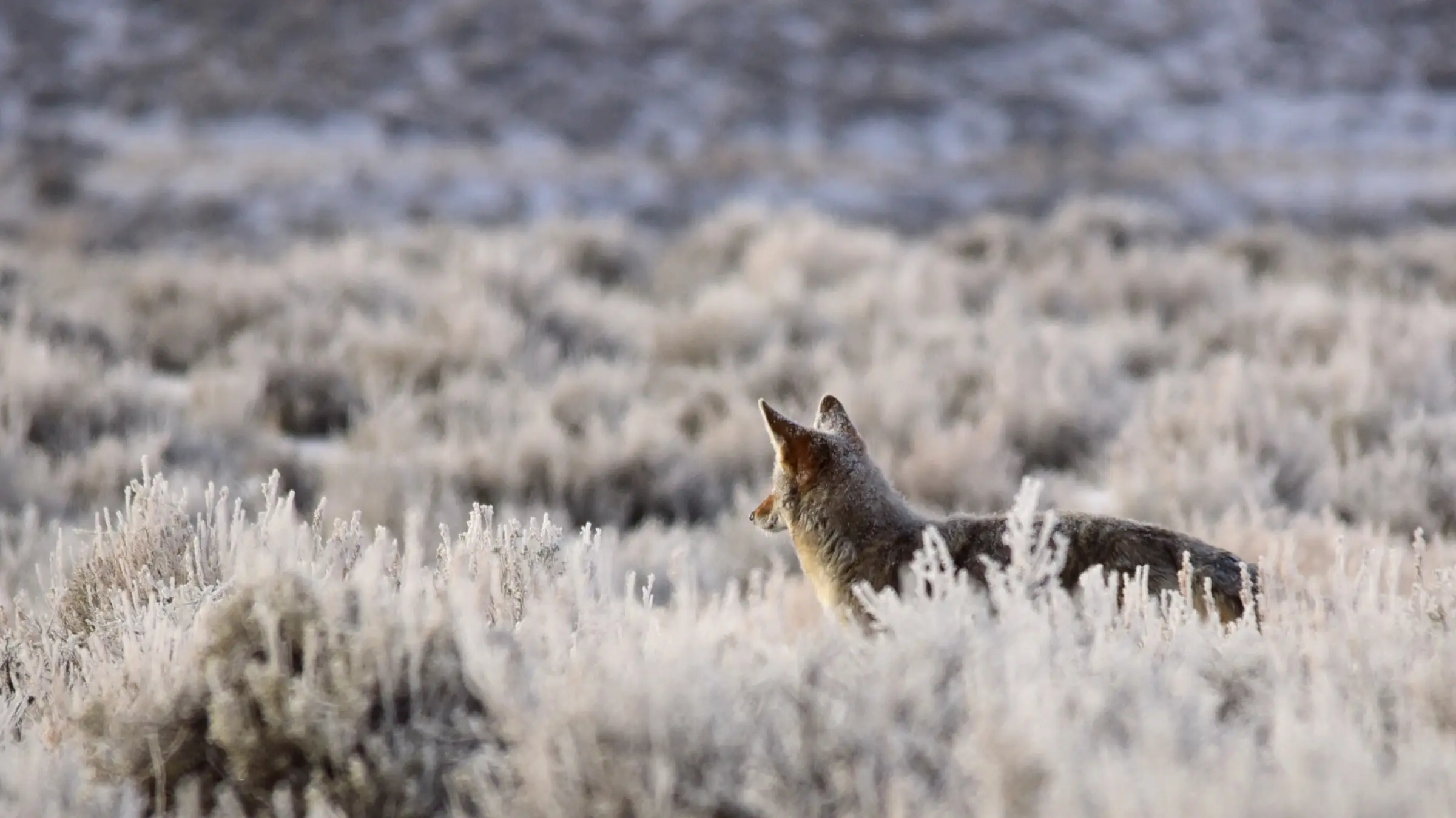
The question I get more than any other is what sound I’m running. What’s on the call, what order, how long between sequences.
It’s the wrong variable. There is no magic sound, no secret sequence, nothing you can load onto a caller that turns an unwilling coyote into a willing one. The sound is a dinner bell, not a password. It announces that something is available. Whether anybody comes is decided by who is in earshot and what kind of day they’re having.
It is the most useful thing I can tell somebody who is calling hard and not killing anything, because it moves your attention off the one thing that is cheap to change and onto the things that decide the stand.
The call is a dinner bell, not a password
People treat a coyote call like a combination lock. Get the right sound in the right order and the animal is obliged to come. Coyotes have never read that.
Ring a dinner bell at a house where everybody’s hungry and you’ll get a crowd. Ring the same bell an hour after a big lunch and nobody moves, and it isn’t because you rang it wrong. That’s the whole thing. The bell is not the variable. The appetite is.
Which is why coyotes get killed over sounds nobody sells. Sirens on a highway shoulder pull them in. Guys have called them with a phone speaker playing something awful. I’ve heard some genuinely terrible calling get charged by a hard-running dog, and I’ve heard beautiful, textbook sequences played to an empty sagebrush flat for twenty minutes.
There is one hard limit. The range of sounds that will work is enormous, but it stops dead at anything that says human. I found that out on an older ICOtec that had been loaded from a Mac, which meant it fired up and announced “Please insert SD card” in a loud human voice, over and over. Nothing on earth comes to that. Almost any prey-shaped noise is inside the range. One category sits permanently outside it.
The variable is the coyote, not the sound
Researchers comparing bold and shy behavior in coyotes found the expected gap between populations, with urban animals bolder than rural ones. The more useful finding is the one inside each population. There was, in their words, a great deal of individual variation in both, with bold and shy animals living side by side on the same ground.
They also measured how consistent an individual coyote was with himself across repeated encounters, and repeatability came out very low, around 0.14 on flight distance and 0.12 on behavioral state. A score near zero means the same animal, measured again, behaves differently.
The same coyote is not reliably the same coyote twice. So when a sound “worked” on Tuesday and did nothing on Thursday, you have not learned anything about the sound. You have watched one animal have two different days.
Which is the problem with the way most hunters test a call: run a sound, kill or don’t, form an opinion. The sample is one, the animal is inconsistent, and the conclusion is noise.
What guiding taught me the expensive way
I spent years guiding, and it beat this into me from an angle most hunters never see: I watched dozens of different people hunt the same ground with wildly different equipment.
Clients turned up with rifles worth more than my truck. Glass I couldn’t afford. Callers with every sound library the manufacturer sold, and a lot of confidence about which sound was the one. What decided their hunt, almost every time, was none of that. It was whether I’d put them on a piece of ground that held a coyote who hadn’t been bothered lately.
I’ve had clients turn up with three hundred sounds on the caller and a plan to work through every one of them, and it tends to go the same way. We sit a stand and do exactly that, cycling sound after sound at a bowl that’s been driven past by every truck on that road for a month. Nothing. The next morning I walk him forty minutes off the two-track to a bowl nobody bothers with, play the most ordinary cottontail distress on the unit, and he kills a dog inside four minutes. Same caller, same guy, same sounds available. Different bowl.
You can buy a better call. You cannot buy a coyote that wants to come.
What “callable” actually means
A callable coyote is three things at once: in earshot, hungry, and not expecting you. Miss any one and the best sound in the world is a speaker talking to itself.
Hungry is not a constant, and it isn’t the same in your country as in mine. In one southeastern study, what coyotes were actually eating swung hard from month to month — rabbit turned up in anywhere from 13.8% to 34.3% of samples depending on the month, peaking January through April, while fruit ran the other way and peaked June through December. The same work found diet shifting with home range size and with how thick the cover was.
That is a hunting fact more than a biology one. What a coyote near you is looking for in February is not what he’s looking for in September, and it isn’t what a coyote three states over is looking for either. That is the actual reason a sound that crushes it for somebody online does nothing for you, and it is not a reason to buy their call.
Not expecting you is harder than it sounds. There’s a Utah study that ran 660 scent stations and photographed what came to them, and coyotes were dramatically more cautious than kit foxes on the same ground: close approaches on roughly 29% of coyote visits against about 56% for kit foxes. The part that surprised me is that coyote wariness barely moved between protected land and land that’s hunted.
So the comfortable story, that the coyotes on your ground are spooky because somebody called them, is at best half of it. A good deal of that caution is just what a coyote is. Pressure makes it worse. It doesn’t create it.
“There are coyotes everywhere here and I can’t call one”
I hear this constantly. He hears them howling every night, they’re clearly right there, and nothing comes.
If they’re howling at you while you’re set up and calling, they already know. They watched you walk in, or they’ve been called before on that ground, or they simply aren’t hungry enough to investigate. A coyote sounding off at your stand is not a coyote you failed to reach. He’s a coyote who answered and declined.
Hearing coyotes is not the same as having callable coyotes, and treating the two as the same thing is why people burn a whole season on one drainage. If you want the full list of reasons an interested coyote stops short, that’s its own article.
How to actually find out what works on your ground
You do have to figure out what your coyotes respond to. That’s real. It just can’t be done the way most people do it.
- Judge a sound over a season, not a stand — given how inconsistent individual animals are, anything under a couple of dozen stands is a coin flip you're reading as a result
- Change one thing at a time — new sound, new bowl and a new time of day on the same morning teaches you nothing about any of the three
- Write it down the same day — date, ground, wind, what you played, what showed and how it came. Memory quietly edits itself toward whatever you already believed
- Count the blanks — a sound is not good because you killed over it twice. It's good because you killed over it twice in fifteen stands and the other one went two in fifteen
- Change ground before you change sounds — it's the bigger lever and it's the one nobody wants to pull, because ground costs a walk and a sound costs a button
Most of what people call a calling problem is a stand selection problem or a timing problem wearing a calling problem’s clothes.
A starting point, month by month
Everything above says the sound is not the variable, and it isn’t. But “it depends” is a useless place to leave somebody who just wants to know what to put on first, so here is where I’d start in a given month and, more usefully, why.
Treat the why column as the real content. If you understand why a young coyote in October behaves differently from a paired male in February, you can pick a sound in a month this table doesn’t cover.
| Month | What the coyotes are doing | Where I’d start | Why |
|---|---|---|---|
| Aug–Sep | Pups are grown and starting to move off. Hot, and mostly a young-dog game | Simple prey distress, with bird sounds behind it | They’re inexperienced and hungry, and the simplest thing in the library is enough. A mature coyote howl can push a young dog away rather than pull him in |
| Oct–Nov | Dispersal proper. The most naive animals of the year are on unfamiliar ground | Cottontail or jackrabbit distress | The easiest calling of the season. If a sound is ever going to work on your ground, it works in this window |
| Dec–Jan | Grouped up, fur prime, food getting harder | Distress first, then a lone howl or interrogation howl to locate | Cold and short days make hunger reliable, and vocals start earning their place as the easy dogs thin out |
| Jan–Feb | Breeding. Paired, territorial, intolerant of strangers | Challenge howl, female invitation | He’s coming to find out who’s on his ground, not to eat. Expect him to stop where he can see, and set up so that spot is in range |
| Mar–Apr | Denning. Pairs tied to a den site | Territorial vocals, and distress near known dens | They come to run something off rather than to eat, and they arrive wound up and cautious |
| May–Jul | Pups on the ground and being fed | Pup distress pulls adults hard | The strongest response of the year, and the one to think hardest about before you use it. A nursing female is a whole litter |
Three honest caveats on that table. It’s the pattern in my country and it will slide by a few weeks in yours. It says nothing about what is legal where you are, which is a per-state question and the reason the regulations index exists. And it is still a starting point rather than an answer, for exactly the reason the rest of this article gives: run it for a season, count the blanks, and let your own ground correct it.
What I run, and why it isn’t a recipe
I’ll tell you what’s on my caller, on the condition that you treat it as one guy’s starting point rather than an answer.
Early season I’m mostly on distress. Young coyotes are on their own for the first time, they’re hungry, and they haven’t learned anything yet, so the simplest thing in the library works fine. As the season goes on and the easy dogs are gone I mix in more vocals, because by then I’m hunting animals that have heard a dying rabbit before and haven’t heard anything challenge them lately.
Beyond that I don’t work off a set list, but I’m not chasing variety either, and that distinction matters. Once I find the sound they’re answering, I stay on it. If something produced this morning it’s the first thing I play this afternoon, and I’ll keep playing it until it stops producing. I repeat myself a lot, on purpose.
Most of the switching people do on stand is impatience rather than strategy. You don’t get points for using the library.
If you want the mechanics that sit underneath all of this, the volume, the speaker direction, how long to sit and when to switch, part four of the tips covers it in order. And if you’re still deciding what to buy, that’s a separate question with a real answer, unlike this one.
The short version
Somebody is going to skim to the bottom, so:
- There is no magic sound — almost any prey-shaped noise is inside the range, and the range is wide
- The variable is the animal — coyotes vary hugely between individuals, and the same one isn't consistent with himself
- Callable means three things — in earshot, hungry, and not expecting you
- Hungry is seasonal and local — which is why somebody else's favorite sound is not evidence about your ground
- Test over a season — one stand is a coin flip, and two is two coin flips
- Move before you switch sounds — ground is the bigger lever every time
If you’re calling hard and not killing, the first question isn’t what you’re playing. It’s whether there was a coyote out there who wanted to eat and hadn’t already met you.