
Hunt Mississippi · The official source
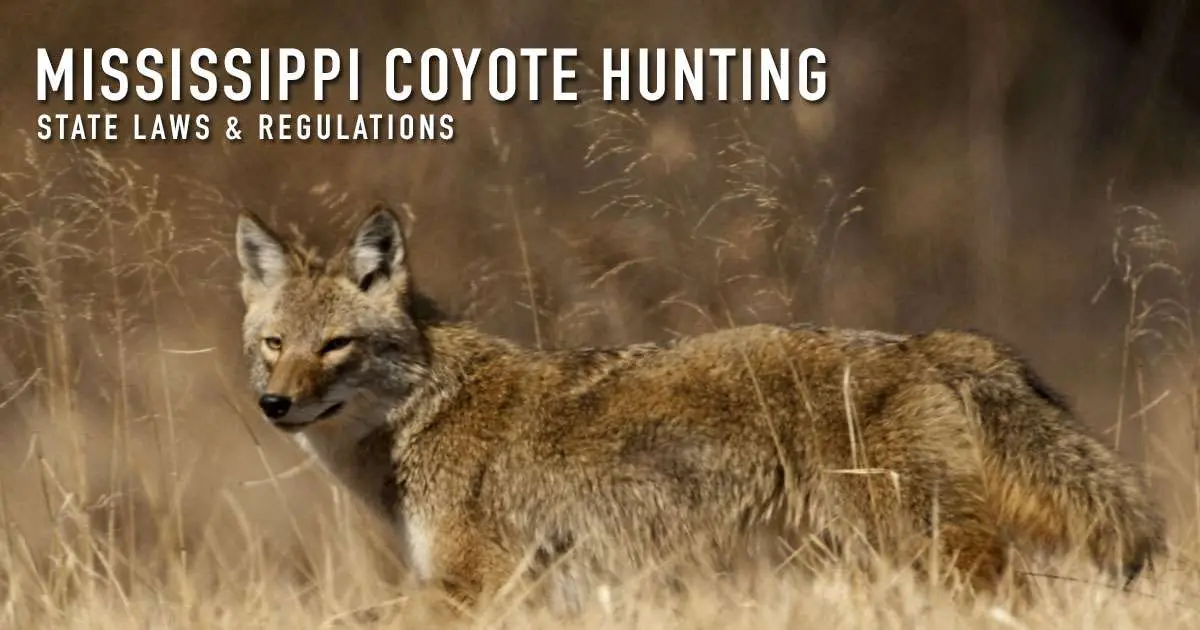
Mississippi calls the coyote a nuisance animal, and the rule that follows is one of the shortest and most permissive in the country. On private land the landowner, the leaseholder, or a designated agent may hunt coyotes year-round, at any time of day or night, with no weapon or caliber restrictions at all.
No night permit. No dedicated season. No optics rule. Thermal, lights, a .300 Win Mag at three in the morning — the regulation simply does not restrict any of it.
What Mississippi does ask for is a piece of paper. If you are not the landowner or leaseholder, you need a written permission letter carrying four specific things, and one of them is an expiry date.
Coyote classification & license in Mississippi
What is the classification of coyotes in Mississippi?
A nuisance animal, by statute:
MISS. CODE ANN. §49-7-1, as amended, classifies nutria, beaver, fox, skunks, coyotes and wild hogs as “nuisance” animals.1
The label is the whole page. Mississippi’s general hunting rules — shooting hours, weapon restrictions, night hunting limits — are written for game animals, and the nuisance rule replaces them wholesale for the six species it names.
Watch the fox, which sits in both lists. A fox is a nuisance animal and a furbearer, so fox trapping runs on the furbearer season while fox hunting runs on the nuisance rule. Coyote is in the same position: it is a nuisance animal for hunting and one of the species a trapping license covers.2
Are coyotes protected in Mississippi?
No. No closed season, no bag limit, and taking is permitted year-round:
Beaver, coyote, fox, nutria, skunks, and wild hogs are classified as “nuisance animals” and may be taken year-round on private lands, and on open public lands that have statewide seasons without special regulations2
Is a hunting license required to hunt coyotes in Mississippi?
Yes:
Persons hunting nuisance animals must possess a valid Lifetime, All Game, or Sportsman’s License, unless otherwise exempt.1
Note which licenses qualify — the cheaper small game license is not on the list. Mississippi asks for an All Game or Sportsman’s license to hunt a nuisance animal.
And there is a second license question that catches people during archery and primitive weapon seasons:
Persons hunting nuisance animals with archery equipment and/or with primitive weapons during archery or primitive weapons season must possess either a valid Lifetime, Sportsman License, or an All Game Hunting License and the Archery/Primitive Weapon Permit, unless otherwise exempt.1
A non-resident pays more, and may need a different license — see what a non-resident needs.
Is hunter education required?
Yes, on the standard pattern. MDWFP requires everyone born after 1 January 1972 to complete a hunter education course before buying a Mississippi hunting license.3
The supervision route is age-scoped, not open to adults. A hunter aged 12 to 15 needs the certificate before hunting alone, and may hunt without one only in the presence and under the supervision of a licensed or exempt hunter at least 21 years old.3 An adult who has never certified does not get a supervised route into a license; they get a course.
Can a non-resident hunt coyotes in Mississippi?
Yes, with a non-resident All Game license. The 2019 guidance was explicit that non-residents 16 and older hunting nuisance animals need an NR All Game type license, and the current rule’s license list works the same way.1
The private-land night provision is open to non-residents on identical terms — the constraint is the written permission, not residency.
Two license points from the resident answer apply to you and are worth repeating here. First, the cheap small game license does not qualify — the rule names Lifetime, All Game and Sportsman’s licenses, and a non-resident small game license is not on that list. Second, if you are hunting with archery equipment or a primitive weapon during those seasons, you need one of those licenses plus the Archery/Primitive Weapon Permit:
Persons hunting nuisance animals with archery equipment and/or with primitive weapons during archery or primitive weapons season must possess either a valid Lifetime, Sportsman License, or an All Game Hunting License and the Archery/Primitive Weapon Permit, unless otherwise exempt.1
A visitor planning a winter bow trip who buys only the All Game license is one permit short.1
See also is a hunting license required — the license rules there, and the exemptions and add-ons that go with them, apply to you too.
Season, hours & bag limits in Mississippi
What is the season for coyote hunting in Mississippi?
Year-round on private land, and year-round on open public land that runs statewide seasons without special regulations.2
What is the bag limit for coyotes in Mississippi?
None. No daily limit, no possession limit.
What are the legal hunting hours for coyotes in Mississippi?
On private land, none — any time of day or night:
Landowners and any leaseholders may hunt nuisance animals year-round at any time of day or night with no weapon/caliber restrictions on property titled in their name or otherwise owned, or leased by them.1
That single sentence does more work than most states’ entire night-hunting framework. It removes the hours, the weapon list and the caliber ceiling in one clause.
Mississippi’s general shooting hours — half an hour before sunrise to half an hour after sunset — govern resident game, not nuisance animals.
Can you hunt coyotes during deer or big game season?
Yes, and there is no closure — but two requirements switch on.
Hunter orange, and Mississippi asks for more of it than most states:
Persons hunting nuisance animals during any open gun season on deer will be required to wear, in full view, 500 square inches of solid unbroken hunter orange, unless they are hunting from a fully enclosed stand.1
Five hundred square inches is a vest and a cap, and “solid unbroken” rules out camouflage-orange patterns. The enclosed-stand exemption is the only way out of it.
And dogs come off the table in spring:
Nuisance animals may not be hunted or pursued with dogs during the open spring turkey season.1
Night hunting in Mississippi
Can you hunt coyotes at night in Mississippi?
Yes, on private land, with no permit and no season. The provision is worth reading twice because of how little it asks:
Landowners and any leaseholders may hunt nuisance animals year-round at any time of day or night with no weapon/caliber restrictions on property titled in their name or otherwise owned, or leased by them.
Designated agents of the landowners / leaseholders may hunt nuisance animals year-round at any time of day or night with no weapon / caliber restrictions, provided they have written permission from the landowner or leaseholder in his or her possession, when hunting nuisance animals.1
The permission letter has a specified shape, and it is the one administrative requirement on this page:
Permission letters must be signed and dated by the landowner or leaseholder, shall include: the contact information of the landowner or leaseholder; the contact information of the permitted person; and a specific a date of expiration.1
Four things: both parties’ contact details, a signature, a date, and an expiry. A letter with no expiry date does not meet the rule. Renew them annually and keep a copy on your phone.
Can you use artificial lights for coyote hunting in Mississippi?
Yes, without restriction on private land. The nuisance provision lifts weapon and caliber limits and sets no equipment condition at all — no color, no power, no mounting, no vehicle rule specific to nuisance animals.1
This is a genuine outlier. Mississippi’s general night-hunting restriction — handguns or rifles no larger than .22 standard rimfire and shotguns with shot no larger than No. 6 — is written for raccoon and opossum hunting. The nuisance rule’s “no weapon/caliber restrictions” is what takes coyote hunters out of it.
Can you use night vision or thermal in Mississippi?
Neither is restricted, and that is a researched answer rather than an assumption.
Checked, in order:
- 40 Miss. Admin. Code Pt. 2, Ch. 7, Rule 7.1, the nuisance animals rule that governs coyote hunting — it addresses licenses, land, hours, weapons, caliber, calls, orange, dogs, possession and sale, and mentions no optics of any kind.1
- MDWFP’s Furbearing and Trapping Regulations, which govern coyote trapping — trap types, lure volumes, road setbacks, tagging, CITES. No optics.2
- The general night-hunting weapon restriction, which is scoped to the species hunted at night under the ordinary rules rather than to nuisance animals.
Against a rule that expressly removes weapon and caliber restrictions for night hunting on private land, thermal and night vision are lawful on the ordinary reading.
An absence is not a permission. Nobody in Mississippi has written this answer down, so it can move at a single Commission meeting. Sign up below and you will hear if it changes.
Are there specific weapons restrictions for hunting coyotes at night in Mississippi?
No — the rule says so in as many words: “no weapon/caliber restrictions,” twice, once for landowners and leaseholders and once for designated agents.1
That makes Mississippi one of a very small number of states where the same rifle you carry at noon is lawful at midnight with nothing added.
Firearms, ammunition & suppressors in Mississippi
What firearms are allowed or restricted for coyote hunting in Mississippi?
On private land, none are restricted.1 Archery and primitive weapons carry the license condition noted above during their respective seasons.1
Are suppressors allowed for coyote hunting in Mississippi?
Yes. Mississippi permits civilian suppressor ownership and hunting with a lawfully registered suppressor, and the nuisance rule imposes no equipment restriction. The requirements are federal: ATF Form 4, a $200 stamp and the wait.
Are there any ammunition restrictions?
None for coyotes on private land.1
Can you hunt using a .22 LR or other rimfire cartridge?
Yes. There is no minimum caliber. A rimfire is legal and undergunned; a centerfire is the better tool in Delta farmland.
Is there a magazine capacity limit for hunting coyotes in Mississippi?
No. “No weapon/caliber restrictions” carries no capacity limit, and Mississippi sets none in its firearms law. A standard AR-15 is lawful, day or night.
Calls, decoys, bait & dogs in Mississippi
Are electronic calls allowed for coyote hunting in Mississippi?
Yes, expressly:
Nuisance animals may be hunted with the aid of electronic calls.1
The flip side is a trapping rule people miss:
It is illegal to trap with the aid of bait, recordings of bird or animal calls, or electrically amplified imitations of calls of any kind.2
Legal for hunting, prohibited for trapping. If you run a caller near your trap line, keep the two activities separate.
Are decoys allowed for coyote hunting in Mississippi?
Yes, including motion decoys. Live decoys are prohibited.
Is baiting allowed for coyote hunting in Mississippi?
For hunting, the nuisance rule imposes no bait restriction on coyotes — the feeding provisions it does carry are written for wild hogs, including the CWD Management Zone permit requirement.1
For trapping, the limits are specific and easy to break:
Lure or bait is allowed for trapping furbearers, beaver, nutria, coyote, skunk, and fox, provided that no more than two and one-half (2.5) cubic inches of such lure may be placed or located within twenty (20) feet of any trap. (The lure amount of 2.5 cubic inches is approximately the volume equivalent of a regulation-sized golf ball). All lure within twenty (20) feet of any trap must be covered and not visible from above.2
The “not visible from above” condition is a raptor-protection rule and it is enforced. There are no lure restrictions inside live-cage traps up to 42 × 15 × 20 inches.2
The usual contamination warning applies for deer, and inside a CWD Management Zone the feed rules tighten considerably.1
Can you use dogs to hunt coyotes in Mississippi?
Yes, with one seasonal closure:
Nuisance animals may not be hunted or pursued with dogs during the open spring turkey season.1
Note that it covers pursuit, not only killing, so running hounds through turkey woods in April is the offence whether or not a coyote is taken.
Private property, vehicles & public land access in Mississippi
Is it legal to shoot coyotes on private property (e.g. in your backyard) in Mississippi?
On rural private land, yes — and private land is where the whole permissive framework lives:
Nuisance animals may be hunted, trapped, taken, killed, chased, or pursued on private lands.1
Landowners and leaseholders need nothing beyond the license; agents need the written permission letter.1 In town, municipal discharge ordinances govern.
Can you hunt coyotes from a motorized vehicle in Mississippi?
The nuisance rule sets no vehicle condition, and Mississippi’s general prohibitions on shooting from a public road or right-of-way apply as they do to any hunting. Confirm with MDWFP before working from a vehicle on your own ground — the “no weapon/caliber restrictions” language is about equipment, and should not be read as lifting rules about roads.
Can you hunt coyotes on public land in Mississippi?
Sometimes, and you have to ask first. This is the sharpest limit in Mississippi and the rule states it plainly:
On public lands, the governmental entity charged with the management of said lands may or may not allow the taking of nuisance animals subject to applicable laws, rules, or regulations. It is the hunter’s responsibility to check with the entity managing the property before hunting nuisance animals on those lands.1
The trapping regulations put the same point from the other side: nuisance animals may be taken year-round “on open public lands that have statewide seasons without special regulations.”2 A WMA with its own season structure is not that.
There is no public-land equivalent of the private-land night provision. If you do not have private permission, Mississippi is not the open state it looks like.
Is it legal to trap or snare coyotes in Mississippi?
Yes, with a trapping license — and unlike hunting, trapping coyotes is licensed separately:
A trapping license is required of anyone 16 years of age or older who traps furbearers (bobcat, mink, muskrat, opossum, otter, raccoon, and weasel), or nuisance animals (beaver, coyote, fox, nutria, and skunks) in the State of Mississippi.2
Landowners trapping on land deeded in their name are exempt from the license, but each assistant 16 or older needs one.2
The operational rules are detailed:
- Trap identification by metal tag or permanent inscription, using your MDWFP Customer Number. Unmarked traps may be removed by a conservation officer.2
- Check every 36 hours.2
- No trap within 100 feet of any street or public road, except that landowners and their agents may set on their own property within 100 feet of a road but not within the maintained right-of-way.2
- Snares, conibear and body-gripping traps set within 100 feet of a road must be at least 50% submerged; foothold traps must be completely submerged.2
- On public lands, no conibear or body-gripping trap with an inside jaw spread over 7 inches unless partially submerged.2
- A Trapper Harvest Survey must be returned annually, and failure to return one can cost you next year’s license.2
Unlike hunting, coyote trapping is unrestricted by season: “It is unlawful to trap any animal, except beaver, coyote, fox, nutria, skunk, and wild hogs, in any period other than the trapping season.”2
Is it legal to poison coyotes in Mississippi?
No. Predator toxicants are restricted-use pesticides handled through USDA Wildlife Services and the Mississippi Department of Agriculture and Commerce, not by private individuals.
Are there protected areas or additional local restrictions in Mississippi?
Yes, four kinds:
- Public land managed by any entity, where you must ask before hunting nuisance animals at all.1
- CWD Management Zones, where feed and food product use is regulated and an Animal Control Permit is required to trap wild hogs over feed.1
- The 100-foot road setback for traps.2
- Municipal ordinances near towns.
After the shot: pelts, bounties & contests in Mississippi
Are there regulations for possessing or transporting dead coyotes or pelts across state lines?
Selling parts is expressly permitted:
Any part of any nuisance animal that has been lawfully taken, may be sold year-round, with the exception of wild hog meat.1
Transport of raw fur has a documentation window that catches trappers:
A trapper may not transport the raw fur or green pelts of fur-bearing animals within the state from eleven (11) days after the close of trapping season until the opening day of the following trapping season, unless each raw fur or green pelt is tagged or documented with the name, address, and trapping identification number of the person who harvested the raw fur or green pelt and the date and place of harvest.2
An official possession tag issued by another state counts as legal documentation.2 CITES tagging applies to bobcat and river otter, not to coyote.2
Can you sell coyote pelts, and do you need a fur handler’s license?
Yes, and the selling right is tied to the trapping license rather than the hunting license:
Only a licensed trapper or resident under sixteen (16) years of age may sell or consign the raw fur, green pelts and dried pelts of fur-bearing nuisance animals.2
Read that carefully. You may hunt coyotes on an All Game license, but selling the hide is a licensed-trapper activity. The selling window is during trapping season and for 30 days after it closes, though a licensed trapper “may possess and maintain in storage the raw fur, green pelts, and dried pelts of furbearing and nuisance animals at any time.”2
Mississippi coyote fur is short and thin — this is a predator-control state, not a fur state.
Can you sell a live coyote in Mississippi?
Yes, and Mississippi is one of very few states where this is expressly lawful. It falls entirely outside the standard question set, so it is worth its own answer:
The only nuisance animals that may be sold alive are coyotes and fox per 40 Miss. Admin. Code Pt. 2, Rule 8.1 (General Rules for Fox, Coyote and Rabbit Pens).1
The mechanism is the enclosure trade:
Coyote and fox may be possessed by licensed fur trappers for the sole purpose of transporting and selling to a MDWFP licensed coyote/fox enclosure. Possession over 30 consecutive days for this purpose is prohibited.1
Live coyotes may otherwise not be possessed at all, except in permitted coyote enclosures.1 If you live-trap coyotes and intend to sell them, you need a fur trapper’s license, a licensed enclosure to sell to, and you may not hold the animal more than 30 days.
Is there a coyote bounty program in Mississippi?
No state bounty. MDWFP does not pay per animal.
County and landowner-association programs appear from time to time as local decisions. Verify any you hear about with the county, because the state publishes no list.
Are coyote contests legal in Mississippi, or can I hunt in Mississippi for an out-of-state contest?
Yes to both. Mississippi has not restricted predator hunting contests.
Two scheduling notes. Every round runs on private land with the permission letters in order — public land needs the managing entity’s blessing, which no contest organizer should assume.1 And a round during any open gun deer season means 500 square inches of solid unbroken hunter orange on every participant, unless they are in a fully enclosed stand.1
Coyotes in Mississippi
Are there coyotes in Mississippi? How many, and where?
Yes, in all 82 counties. Coyotes reached Mississippi from the west in the twentieth century and are now established in every habitat the state has — the Delta, the Loess Hills, the Black Prairie, the Piney Woods and the Coastal Plain, plus the suburbs of Jackson, Hattiesburg and the Gulf Coast.
The Delta’s row-crop country and the pine plantations of the south hold the most workable ground. MDWFP publishes no population estimate.
Are Mississippi coyotes dangerous to people or pets?
To people, very rarely. To livestock, poultry and pets they are a routine problem, and to deer fawns they are the reason a great deal of Mississippi coyote hunting happens — fawn recruitment is the driver behind the state’s permissive rules and behind most landowner interest in predator control.
Unattended small pets on the suburban fringe are at genuine risk.
When is coyote mating season in Mississippi, and when do pups arrive?
Breeding runs January into February, with pups born in April in litters of five to seven. In a warm state pups are moving early and juveniles disperse from late summer.
Mississippi’s rules make the whole year available, so the calendar is a hunting decision rather than a legal one. February gives you breeding-season response and the best fur; late spring and early summer put you on the ground when fawn predation peaks and landowners most want you there.
When are coyotes most active in Mississippi?
First and last light year-round, with heavy night movement — and in Mississippi’s heat, night is when the animals actually want to move for much of the year. That is the practical argument for a state that lets you hunt at any hour.
For the full breakdown of season, weather and moon phase, see when to hunt coyotes.
Are there black coyotes in Mississippi?
Yes, and the Southeast is the best region in the country for them. Melanistic coyotes are reported regularly across Mississippi, and the trait traces to historical hybridization with domestic dogs — it is markedly more common here than in the West.
There is no separate rule for a black coyote. It is a nuisance animal like any other.
These answers get re-checked before they go stale. The verification date at the top of the page is the record of when that last happened, not decoration.
Anything else worth noting about coyote hunting in Mississippi
Mississippi gives private-land coyote hunters more freedom than almost any state in the country and asks for remarkably little in return. The whole framework fits in one rule, and the things that will actually catch you are administrative rather than technical.
Five things to get right:
Your permission letter needs an expiry date. Signed, dated, both parties’ contact details, and a specific expiration. A letter missing any of the four does not satisfy the rule, and this is the requirement most often got wrong.
Buy the right license. Lifetime, All Game or Sportsman’s. A small game license does not cover nuisance animals.
500 square inches during gun deer season. Solid and unbroken, not camo-orange, unless you are in a fully enclosed stand.
Ask before you hunt public land. The managing entity may or may not allow nuisance animal hunting, and it is expressly your responsibility to find out.
Hunting and selling are different licenses. You may hunt coyotes on an All Game license, but only a licensed trapper may sell the hide.
Is it legal to own a coyote as a pet in Mississippi?
No. Live nuisance animals may not be possessed except in permitted enclosures, and for coyotes that means an MDWFP licensed coyote enclosure — not a home.1 Licensed fur trappers may hold one for up to 30 consecutive days for the sole purpose of transporting it to such an enclosure, and for no other reason.1
If you have found an orphaned pup, contact MDWFP at (601) 432-2400 or a licensed wildlife rehabilitator rather than keeping it.
Know something we missed? Contact me and I’ll get it fixed.
Footnotes
-
40 Miss. Admin. Code Pt. 2, Ch. 7, Rule 7.1 — General Regulation for the Taking of Nuisance Animals: classification, license requirements, the private-land day-and-night provision, the permission letter contents, electronic calls, the 500-square-inch hunter orange rule, the spring turkey dog closure, public land, possession and sale of live coyotes, and the wild hog feeding provisions Administrative rule ↩ ↩2 ↩3 ↩4 ↩5 ↩6 ↩7 ↩8 ↩9 ↩10 ↩11 ↩12 ↩13 ↩14 ↩15 ↩16 ↩17 ↩18 ↩19 ↩20 ↩21 ↩22 ↩23 ↩24 ↩25 ↩26 ↩27 ↩28 ↩29 ↩30 ↩31 ↩32 ↩33 ↩34
-
MDWFP — Furbearing and Trapping Regulations: the trapping license requirement for coyote, trap identification, the 36-hour check, the 100-foot road setback and submersion rules, the 2.5-cubic-inch lure limit, the prohibition on trapping with calls, the year-round nuisance animal exception, raw fur transport documentation, who may sell pelts, CITES tagging, and the Trapper Harvest Survey Administrative rule ↩ ↩2 ↩3 ↩4 ↩5 ↩6 ↩7 ↩8 ↩9 ↩10 ↩11 ↩12 ↩13 ↩14 ↩15 ↩16 ↩17 ↩18 ↩19 ↩20 ↩21 ↩22 ↩23
-
MDWFP — Hunter Education: everyone born after 1 January 1972 must complete a hunter education course before purchasing a Mississippi hunting license, the certificate requirement for hunters aged 12 to 15 hunting alone, and the supervision exception requiring a licensed or exempt hunter at least 21 years old Web edition ↩ ↩2
From the field
Questions and answers from hunters over the years. Comments are closed; contact me if you spot something out of date.
Donald S. · 2017-11-12
I have two fox pro callers for sale All new in the box a FOX PRO Shockwave $325 A Foxpro fusion $225 you pay for the shipping all are brand new (no) refurbs here BRAND NEW ask for Don I am also looking for a place to hunt near Vicksburg MS call or text 907-5194313
Franklin K. · 2018-12-03
does the “there are no weapon/caliber restrictions” cover a ‘night/day’ scope for nuisance animals?. Is it legal to use a night scope that works either day or night for deer hunting during legal shooting hours. I am 70 years old and the night scope would help verify legal size antlers during very low light conditions during early and late legal shooting times.
This information is for informational purposes only and is not intended as legal advice. This website has no affiliation with any department of the above-mentioned state. Coyote hunting laws can change frequently and vary by locality — always verify the most current regulations directly with your state's wildlife agency or local authorities before hunting. Last updated: September 2026.